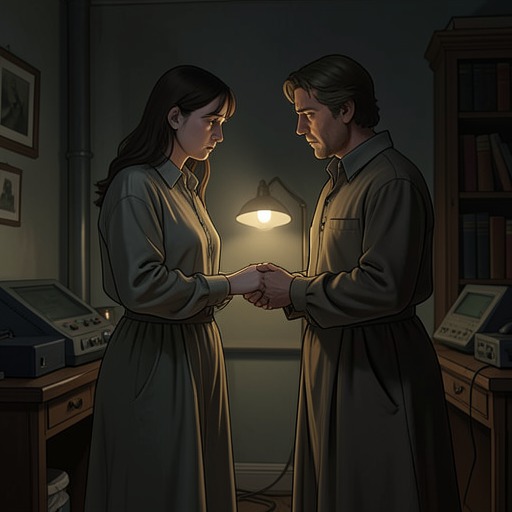
Michael Tolland’s grief over his wife’s death
Deception PointMichael Tolland’s grief over his wife’s death is not a loss he simply leaves behind: it returns most forcefully when he is tired, alone, or celebrating, interrupting the present with the memory of the future he and Celia expected to share. Her death ends their marriage, but its consequences persist in Tolland’s work, his guarded social life, and the way a later moment of scientific triumph becomes a setting for remembered absence.
Celia’s illness and death
Six months after Tolland was excitedly telling Celia that NBC wanted him to host an oceanic documentary series and might make a pilot the following year, the life they had imagined together changed abruptly. The two were sailing near Catalina when Celia began complaining of pain in her side. They initially ignored it for several weeks, but when the pain became too much, she went to be examined. The diagnosis was advanced lymphoma, rare in someone her age but not unheard of.
Tolland and Celia sought help at countless clinics and hospitals, consulting specialists, but the answer remained the same: her illness was incurable. Tolland quit his job at Scripps Institute and abandoned the documentary opportunity to devote his energy and love to helping her recover. Celia fought the disease while bearing its pain with a grace that deepened his love for her. He took her for long walks on Kingman Beach, prepared healthy meals, and told her stories about what they would do when she got better. Those future plans became a form of hope they could sustain together, but they could not alter the outcome.
Seven months after the diagnosis, Tolland sat beside his dying wife in a stark hospital ward. He no longer recognized her face: the cancer and the brutality of chemotherapy had left her a ravaged skeleton. In her final hours, Celia told him it was time to let go, while Tolland, weeping, said he could not. She urged him to survive and promised him a life beyond their marriage, asking him to find another love. He insisted that he would never want another; Celia answered that he would have to learn. Their exchange makes the coming loss both intimate and unresolved: she offers him a future he cannot yet accept.
Bereavement and return to work
Celia died on a crystal-clear Sunday morning in June. Tolland’s grief is rendered as a loss of direction: he felt like a ship torn from its moorings and thrown adrift in a raging sea, with his compass smashed. For weeks he spun out of control. Friends tried to help, but he could not bear their pity, and their support did not immediately give him a way to live with the absence.
Eventually Tolland understood his situation as a choice between work and death. He threw himself back into Amazing Seas, and the program quite literally saved his life. In the four years that followed, the show took off. This return to work marks a change in the form, not the disappearance, of his grief: the career he had once been willing to leave for Celia becomes the means by which he continues after her death.
His private life, however, remains narrowed by the loss. Friends tried to arrange dates, but Tolland endured only a handful; the encounters ended as fiascos or mutual disappointments. He eventually gave up, attributing his lack of a social life to his busy travel schedule. His best friends understood otherwise: he simply was not ready. Celia’s dying request that he find another love therefore remains in tension with the life he has actually been able to lead. The evidence does not show that he has fulfilled the promise; it shows a man whose work has resumed while intimacy has not.
The return of memory in the NASA dome
The account of Tolland’s bereavement is framed by a later moment at NASA’s dome. After leaving a crowd of NASA personnel who were toasting the meteorite with Canadian beer, he feels exhausted and emotionally drained. Looking around for Rachel Sexton, who is still speaking with the President, he reflects on the possibility that the President wants her to join the group of meteorite spokespeople. Then he quietly slips away from the celebration and crosses the dome, wondering where the civilian scientists have gone.
The deserted extraction pit and the empty dome bring the past into the present. Tolland recognizes that Celia’s absence haunts him especially when he is tired or alone, and during moments of personal triumph or celebration. The contrast is pointed: NASA’s personnel are publicly celebrating a discovery, while Tolland’s own inward response to a moment of achievement is shaped by the person who cannot share it. The pit’s circle of SHABA pylons and the hollow voices of distant memories become part of the setting through which he struggles not to revisit his loss.
The memory does not end with the hospital or with Tolland’s decision to return to work. As he approaches the extraction pit, he shakes off the chill of remembering and sees the meltwater below: the pool shimmers like a moonlit pond, with blue-green specks across its surface. He watches it for a long moment and senses that something about it is peculiar. The scene turns from bereavement back toward the immediate mystery, but the transition shows how the past has interrupted him rather than vanished. Celia’s death remains an active presence in Tolland’s experience even as the plot draws him toward a new discovery.
Narrative significance
Tolland’s grief gives personal cost to his professional success. Before Celia’s illness, the prospective NBC series was a shared source of excitement; during her treatment, he gave up his job and opportunity to care for her; after her death, returning to Amazing Seas became a way to stay alive. The same work thus marks both the life interrupted by illness and the life rebuilt in its aftermath.
The remembered exchange about finding another love also places Tolland’s isolation beside Celia’s final effort to imagine a future for him. He tells her he will never want another, and the account of the years after her death shows that emotional readiness has not followed automatically from survival. The story holds the two truths together: work has restored a direction to his days, while the loss still shapes his capacity for companionship.
The dome scene makes that persistence visible through narrative recurrence. A present-day celebration gives way to a private recollection, and Tolland has to pull himself back from it before attending to the strange lights on the water. His grief is therefore neither a detached backstory nor a completed stage of recovery. It returns at precisely the kinds of moments when he might otherwise be expected to feel only triumph, and it accompanies him as he moves from memory toward the new problem before him.